Jamaican Proverbs
This page will feature a selection of Jamaican proverbs along with translations into standard English and explanations.
- Finger neber say "look here," him say "look yonder."
- If you get your han' in a debil mout' tek it out.
- Peacock hide him foot when him hear 'bout him tail.
- No wait till drum beat before you grine you axe
- You 'fraid fe yeye, you neber nyam head
- A no want a fat mek nightingale foot 'tan' so
- Ebry dyay debble help teef; wan dyay Gad wi help watchman
- Cowad man kip soun' bone
- Cack mowt kill cack
- Dawg no howl ef in ha bone
- If yu noh mash ants, yu noh fine him guts
- Ole fiyah tick easy fe ketch
- Chicken merry, hawk deh near
- Yu cyaan siddung pahn cow bak cuss cow kin
- Yu shake man han, but yu noh shake im hawt
- Fiyah deh a muss-muss (moos-moos) tail, in tink a cool breeze
- Wen chubble tek yu, pickney shut fit yu
- Wha gawn bad a maanin, cyaan kum gud a evelin
- Big blanket mek man sleep late
- Wha sweet a mout' hat a belly
- Me come yah fe drink milk, me noh come yah fe count cow
- Pit inna de sky, it fall inna yuh y'eye
- Yu cyaan ketch Quaku (Harry), yu ketch im shut
- Payshent man ride danki
- Waant aal, lose aal
- Chubble deh a bush, Anancy cyah l'kum a yaad
- Wanti wanti cyaan getti, an' getti getti noh wanti
- New broom sweep clean, but owl broom noe dem cahna
- Mischiff kum by de poun' an' go by de ownse
- Poun' ah fret cyaan pay ownse ah dett
- Willful was'e bring woeful waant
- Noh buy puss inna bag
- Mek wan jackass bray
- Quatti buy chubble, hunjed poun' cyaan pay farri
- Lang run, shaat ketch
- Wan han wash de oda
- De more yu luk, de less yu si
- No matta how kokkuch junk, im noh waak pass fowl yaad
- Hag nyam wha im myne gi im fah
- Bowl go, packy come
- Wan finga cyaan kill louse
- Yuh pred yuh bed haad, yu haffe liddung pan i' haad
- No mug no bruk, no cawfee no dash way
- Ebry dawg hab him day, an ebry puss him 4 o'clock
- Wen mawga plantin wan' fi dead, 'im shoot
- Wen coco ripe, im mus buss
- Wen man belly full, im bruck pat
- Wa de goat du, de kid falla
- Yu nebba see sumoke widout fiyah
- Tek whey yuh get tell yu get whey yu want
- Ef yu cyaan get turkey, yu haffi satisfy wid Jancro
- Good frien' betta dan packet money
- Bifoe gud food pwile, meck belly bus
- Tu much ratta nebba dig gud hole
- Self praise a no no rekumendayshan
- A no ebryting kum fram abuv a blessen
- Wen po' git up, im tun chubble tu de wole
Proverb: If you get your han' in a debil mout' tek it out.
Translation: If you put your hand in the devils mouth, take it out carefully.
Explanation: Act cautiously in getting out of difficulty.
Proverb: Finger neber say "look here," him say "look yonder."
Translation: Finger never says "look here," he says "look yonder."
Explanation: People do not usually point out their own faults.
Proverb: Peacock hide him foot when him hear 'bout him tail.
Translation: The peacock hides his foot when he hears about his tail.
Explanation: A proud person does not like his little weaknesses exposed.
Proverb: No wait till drum beat before you grine you axe
Translation: Do not wait until the drum beats before you grind your axe.
Explanation: Be prepared for all eventualities.
Proverb: You 'fraid fe yeye, you neber nyam head
Translation: If you are afraid of the eye, you will never eat the head.
Explanation: If you regard too much the good opinion of any one you will never prosper.
Proverb: A no want a fat mek nightingale foot 'tan' so
Translation: It is not for the want of fat that the nightingale's legs stand so.
Explanation: Do not judge by appearances.
Proverb: Ebry dyay debble help teef; wan dyah Gad wi help watchman.
Translation: Every day the devil helps the thief; one day God will help the watchman.
Explanation: We should not despair when it appears to us that unscrupulous persons continue to take advantage of us with no apparent deterrent. God never sleeps, and is fully aware of everything occurs. He will one day reward the efforts of the faithful.
Proverb: Cowad man kip soun' bone
Translation: A cowardly man keeps sound bones.
Explanation: It is better to be thought of as a coward than to give away one's life through impetuous behaviour. It is certain that, as in the old chinese proverb. "The man who fights and runs away, will live to fight another day".
Proverb: Cack mowt kill cack
Translation: The rooster was killed by hsi own mouth. (The butcher would not have known where to find him if he had not opened his mouth to crow.)
Explanation: One should never boast, nor should one speak out of turn. We should choose our words with care, lest we, by our own tactlessness, cause ourselves unhappiness.
Proverb: Dawg no hol ef im ha bone
Translation: The dog does not howl if he has a bone
Explanation: The dog is an animal which is very fond of bones, and is not likely to appear miserable if it has bones to gnaw on. Similarly, people do not become upset or agitated if they are comfortable. It is also difficult for some persons to lobby against issues which do not directly concern them.
Proverb: If yu noh mash ants, yu noh fine him guts
Translation: If you do not smash an ant, it is impossible for you to find its guts.
Explanation: It is only when you are closely involved with some persons that you are able to really know them.
If one is not provoked, it is impossible to know the extent of his fury.
Proverb: Ole fiyah tick easy fe ketch
Translation: Old fire sticks are easily re-kindled.
Explanation: It is much easier to light coals which have been burnt before, than to get a fire going with fresh logs. Similarly, if a relationship has previously existed between two people, it is easier to rekindle the flames of love than to start a new relationship with someone else.
Proverb: Chicken merry, hawk deh near
Translation: The chicken, unaware of the danger posed by the hovering hawk, makes merry.
Explanation: Danger can lurk in some of the most unexpected places. We should temper, therefore, our most light-hearted moments with a little sobriety.
Proverb: Yu cyaan siddung pahn cow bak cuss cow kin
Translation: You cannot sit on the back of the cow and curse the skin of the cow.
Explanation: We should not disparage others. Worse yet, we should never be ungrateful to, or disdainful of, those who help us.
Proverb: Yu shake man han, but yu noh shake im hawt
Translation: You can shake a man's hand, but you cannot shake his heart.
Explanation: It is impossible to detect what a person has in his mind toward you through mere physical contact. Do not, therefore, take people, their opinions, or their feelings for granted.
Proverb: Fiyah deh a muss-muss (moos-moos) tail, in tink a cool breeze
Translation: There is a fire blowing at the tail of the mouse, but he believes he is feeling the effects of a cooling breeze.
Explanation: Many times, in our naivete, we remain unaware of impending danger until it actually overtakes us. Also, the foolhardy blithely interpret the signs of danger to mean that all is well.
Proverb: When chubble tek yu, pikney shut fit yu
Translation: When you find yourself in trouble, a child's shirt fits you.
Explanation: It is ridiculous to contemplate the sight of a full-grown man fitting comfortably into a child's shirt. However, one can readily understand that when we are in trouble, we appreciate whatever help we can get to extricate ourselves. This is so, even if under normal circumstances we would have thought such help woefully inadequate.
Proverb: Wha gawn bad a maanin, cyaan kum gud a evelin.
Translation: What went wrong in the morning cannot be remedied in the evening.
Explanation: It is unwise to spend valuable time worrying about those problems we cannot solve. Also it makes no sense to take precautions after we carelessly allowed a situation to get out of hand.
Proverb: Big blanket mek man sleep late
Translation: A thick blanket causes a man to sleep late.
Explanation: An over-abundance of luxuries causes one to become complacent, and to take life's blessings for granted.
Proverb: Wha sweet a mout' hat a belly
Translation: What tastes sweet in the mouth burns the belly.
Explanation: Some things are not good for us, although they appear to be exactly what we want. We should be cautious about what we latch on to, lest we cause ourselves much pain and embarassment.
Proverb: Me come yah fe drink milk, me noh come yah fe count cow
Translation: I came here to drink milk, not to count cows.
Explanation: Mind your own business. Enjoy what you are entitled to. Don't worry about details which do not concern you.
Proverb: Pit inna de sky, it fall inna yuh y'eye
Translation: If you spit into the sky, it falls into your eye.
Explanation: What you do to, or wish for others, could eventually be the cause of your own downfall. Be careful of how you treat others.
Proverb: Yu cyaan ketch Quaku (Harry), yu ketch im shut
Translation: If you cannot catch Quaku (Harry), yu ketch im shut.
Explanation: It is not always possible to get everything you want. Be satisfied with what little you have, until you are able to get all you want. Having caught Quako's shirt, you are all the closer to catching him.
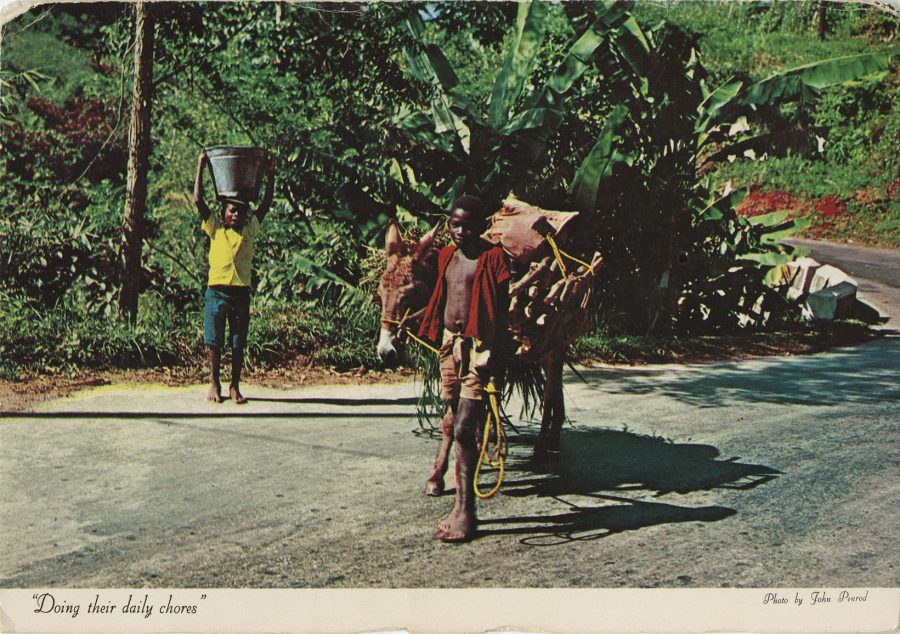
Proverb: Payshent man ride danki
Translation: A patient man rides donkey.
Explanation: It is customary that travellers in a great hurry are loath to go via the slow but sure donkey. For them, a horse, used to galloping at terrific speeds for sustained periods seems a more logical choice. However, the donkey, although much slower, eventually gets to its journey's end. Similarly, we must exercise great pateience in order to reach our goals.
Proverb: Waant aal, lose aal
Translation: If you want everything you see, you will eventually lose all.
Explanation: Take just what you can comfortably manage, rather than attempt to grab everything for yourself, lest you destroy all in the process.
Proverb: Chubble deh a bush, Anancy cyah l'kum a yaad
Translation: There is trouble in the business, and Anancy takes it home.
Explanation: Anancy, the folk hero of West African origin, is never satisfied with leaving things in their proper place. He sometimes takes home the spoils of his foraging, many times to the unhappiness of his family. What does not concern us we should leave strictly alone.
Proverb: Wanti wanti cyaan getti, an' getti getti noh wanti
Translation: He who wants it desperately cannot get it; he who gets it easily does not want it or appreciate it.
Explanation: Be thankful for the blessings that come to you always realising that many of the things we take for granted are luxuries to others.
Proverb: New broom sweep clean, but owl broom noe dem cahna
Translation: The new broom sweeps clean, but the old broom knows all the corners.
Explanation: We should strive for a happy blend between the old and the new, combining the freshness of the new with the valuable experience of the old.
Proverb: Mischiff kum by de poun' an' go by de ownse
Translation: Mischief comes by the pound and goes by the ounce.
Explanation: Mischief makers can stir up a tremendous amount of trouble with only a few words or maybe one action. The effects of this can be difficult to minimize. Let us not be mischief-makers. We could hurt ourselves and others irreparably.
Proverb: Poun' ah fret cyaan pay ownse ah dett
Translation: One pound of fretting cannot repay one ounce of debts.
Explanation: Problems are not solved by worrying. The time spent fretting could be more gainfully spent on considering workable alternatives and solutions.
Proverb: Willful was'e bring woeful waant
Translation: Willful waste brings woeful want.
Explanation: Don't willfully waste what you have or you could end up betterly regretting what you wasted when you do find yourself in need.
Proverb: Noh buy puss inna bag
Translation: Do not purchase a pussycat in a bag.
Explanation: Examine carefully whatever you purchase or accept from someone else. In matters of the head and heart, do not be quick to accept a person as the "genuine article" without a thorough investigation.
Proverb: Mek wan jackass bray
Translation: Allow one jackass (donkey) to bray at a time.
Explanation: It is difficult to see the merit in other persons' ideas if everybody attempts to speak at the same time. Also, if someone is speaking foolishly, avoid adding to the confusion.
Proverb: Quatti buy chubble, hunjed poun' cyaan pay farri
Translation: A penny-halfpenny (1 1/2d) buys trouble, one hundred pounds (£100) cannot pay for it.
Explanation: Little blunders can cause us to find ourselves in situations so complex that we cannot extricate ourselves.
Proverb: Lang run, shaat ketch
Translation: Long run, short catch.
Explanation: It may take a long while for you to be caught and punished for wrong-doing, but you will be caught one day.
Proverb: Wan han wash de oda
Translation: One hand washes the other.
Explanation: One good turn deserves another.
Proverb: De more yu luk, de less yu si
Translation: The more you look, the less you will see.
Explanation: It is impossible to know every single detail about any matter. Also, the more you find out, the less you know.
Proverb: No matta how kokkuch junk, im noh waak pass fowl yaad
Translation: No matter how drunk the cockroach becomes, he never makes the mistake of walking past the yard of the fowl.
Explanation: The cockroach is considered to be a delicacy for fowls. In the interest of self-preservation, cockroach is always reluctant to go past any area where he may be easily caught by a fowl. For humans, the same should apply, self-preservation being the first law of the species.
Proverb: Hag nyam wha im myne gi im fah
Translation: The hog/pig eats whatever its mind gives it for [or wants].
Explanation: To each, his own.
Proverb: Bowl go, packy come
Translation: Bowl goes, calabash comes.
Explanation: It was very common occurence in traditional Jamaican life to see covered dishes carrying some delicious meal being borne by a child, and bound for some neighbour's home. It was also customary, although certainly not mandatory, for the bearer to return with something for the sender, perhaps in a packy (calabash scraped and used as a bowl).
Also, one good turn deserves another.
Proverb: Wan finga cyaan kill louse
Translation: One finger alone cannot kill lice.
Explanation: Co-operation is necessary for projects involving more than one person.
Proverb: Yuh pred yuh bed haad, yu haffe liddung pan i' haad
Translation: If you spread your bed hard, you must lie on a hard bed.
Explanation: You must accept responsibility for your actions, and whatever you sow, you will surely reap.
Proverb: No mug no bruk, no cawfee no dash way
Translation: The mug is not broken, therefore the coffee is not thrown away (or wasted).
Explanation: Even in the most difficult of times, if total devastation has not occurred, one should count his/her blessings.
Do not blow simple matters out of proportion.
Proverb: Ebry dawg hab him day, an ebry puss him 4 o'clock
Translation: Every dog has his day, and every cat has his 4 o'clock.
Explanation: We should not behave as if we are better than others, or allow our position in life to blind us to the fact that tremendous opportunities can be given to those persons whom we would least expect to reap these benefits. ("Your day will come.")
Proverb: Wen mawga plantin wan' fi dead, 'im shoot
Translation: When a meagre plantain wants to die, it shoots.
Explanation: After a plantain tree shoots and bears a bunch of the familiar fruit, it has ended its useful life, and dies thereafter. When we are no longer concerned about the safety of our persons, the preservation of our good character of job, or family, then we are to apt to behave stupidly.
Proverb: Wen coco ripe, im mus buss
Translation: When the cocoa (cacao) ripens, it bursts.
Explanation: It is easy to identify the intentions of an individual by his/her actions.
Proverb: Wen man belly full, im bruck pat
Translation: When a man's belly is filled, he breaks the pot.
Explanation: When man is satisfied, he often forgets what hunger or need is, and will be indifferent to the sources of his repast or succour, until he again finds himself in need.
Proverb: Wa de goat du, de kid falla
Translation: What the goat does, the kid follows.
Explanation: Children absorb behavioural cues from their parents and other significant adults in their lives. We should set good examples for our children.
Proverb: Yu nebba see sumoke widout fiyah
Translation: You never see smoke without fire.
Explanation: Sometimes, actions that appear to be trivial, are actually indications of some deep-rooted resentment, or of trouble or romance brewing.
Proverb: Tek whey yuh get tell yu get whey yu want.
Translation: Take what you can get until you can get what you want.
Explanation: Every opportunity, well used, can be a stepping stone to realization of your ultimate goals.
Proverb: Ef yu cyaan get turkey, yu haffi satisfy wid Jancro
Translation: If you are unable to get turkey, then you must be satisfied with John Crow.
Explanation: No well-thinking Jamaican would be "caught dead" with a portion of crow's meat in his plate. However, this proverb simply advises us to be prepared to accept situations that may not be to our liking, for peace sake. Sometimes second-best is not so bad after all.
Proverb: Good frien' betta dan packet money
Translation: A good friend is better than money in the pocket.
Explanation: No matter how valuable our material possessions may be to us, a good friend, especially in times of trouble, is always proven to be of much more worth. We should treasure our friends, not only recognizing them when we are in need.
Proverb: Bifoe gud food pwile, meck belly bus
Translation: Before allowing good food to spoil, allow the belly to burst.
Explanation: Taken literally, this proverb could see the demise of many persons who are unable to control their appetite. The moral behind this old saying, however, is that one should make every good use of life's opportunities; also, never waste or discard today that which you or someone else may be able to use tomorrow.
Proverb: Tu much ratta nebba dig gud hole
Translation: Too many rats never dug a good hole.
Explanation: A good job/project/activity could be spoilt if there are too many individuals attempting to carry out the same task. Ideally, work should be delegated, and one should avoid frustrating those who can really do the work, by gently re-deploying those who are time-wasters.
Proverb: Self praise a no no rekumendayshan
Translation: Self-praise is no recommendation.
Explanation: The Bible advises "Let another man praise thee, and not thine own lips." (Proverbs) If the only recommendations of our own worth are pronounced by ourselves, then it is certain that such pronunciations are mere vanity. One should not be too quick to "sound his own trumpet."
Proverb: A no ebryting kum fram abuv a blessen
Translation: Not everything that comes from above is a blessing.
Explanation: Enjoy those blessings which come from above, but do not be misled by deceivers who use their superior positions to dispossess the unfortunate.
Proverb: Wen po' git up, im tun chubble tu de wole
Translation: When the poor man gets up, he becomes trouble to the world.
Explanation: See meaning for proverb above. Also, the elevation of someone who used to be disdained or sneered at by others, could be cause for much disturbance in the minds of those who did not wish him well.